Posts

Showing posts with the label 08: Debt–Foreclosure–Bankruptcy

Filing Bankruptcy While Averaging $115,881 per Month?

Image
Yes, this is what Warren Sapp, former NFL player and Dancing with the Stars contestant did on March 30, 2012.   Mr. Sapp filed for Chapter 7 in South Florida stating that he owes more than $6.7 million to creditors and back-child support and alimony.   His reported assets are $6.45 million.   What does this mean and how did it happen? It happens because Mr. Sapp was spending more than he could afford, even more than his income of $115,000 a month.   Bankruptcy happened because of poor financial decisions, poor financial planning and thinking of the short-term, immediate gratification--not the long-term gain.   It happened because he was living life beyond his means. C hapter 7 bankruptcy is also known as “straight” bankruptcy or liquidation and allows an individual to keep certain exempt property.      Assets are sold by a bankruptcy trustee to repay creditors and many unsecured debts are discharged.   Florida does not allow the bankruptcy...

Prenuptials for All?

Image
‘Kobe Bryant's Wife to Get All Three Houses, Worth $18.8 Million’ , ‘Mel Gibson Loses Half of His $850 Million Fortune to Ex-Wife in Divorce’ . As these headlines spam the news, it gives us pause to consider, should prenuptial agreements be made a requirement prior to granting a marriage license? No one goes into a marriage thinking this has a 50-50 shot. Hurt is the last thing you want bring onto this special someone—but unfortunately, 50% of the marriages end is divorce – so many suffer significant financial distress in dissolution. It is especially difficult to stay civil during this time which is unfortunate to each other as well as impacted children, family members and friends. Sweetheart day is just around the corner. Looking for the perfect Valentine’s gift? Just as every business partnership goes into a contract agreement with a dissolution (sell out, buy-out) clause, should every marriage engage in a prenuptial agreement? Do you state up front in an agreement the steps yo...

Look Who’s Trying to Collect from Beyond the Grave

Image
What happened to your debts when you die? As seniors increase their debt during retirement, you should know what happens to debts when you die.  According to FoxBuisness.com “Nearly 40% of all seniors say they have accumulated debt in their retirement years with no plans to pay it off in their lifetime.  Are the heirs and next of kin responsible? There is not an easy answer and it all depends on the situation.  The first thing to do in all cases is to notify all creditors of the death. Normally, the estate and the executor who handles the estate will liquidate the assets, pay creditors and distribute the proceeds according to your last will and testament or it will be distributed according to state laws. If there is not enough money to pay all creditors, the general order of who gets their money is: 1.  Funeral expenses, taxes and administrative fees 2.  Secured creditors such as mortgage loans, car loans, etc.  These creditors have the rights to the assets...

OWS: Repay Student Loans?

Image
Occupy Wall Street (OWS) protesters have decided not to pay back students loans as a way to protest the high cost of higher education.   Is this a good idea?   Check out what Prof Bob has to say.

Is Student Loan Forgiveness the Answer?

Image
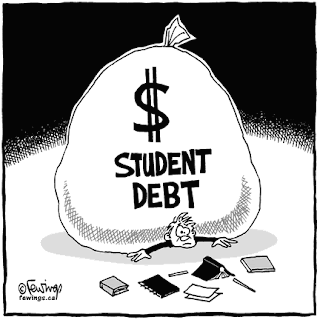
President Obama announced changes to the “Pay As You Earn” plan on Wednesday, October 26, 2011 that would/could ease the repayment of student loans. According to the College Board, the average public in-state tuition rates are increasing 8.3 percent for the 2011-12 year. President Obama pointed out that the average college graduate owes $24,000 in student loans and that the 2011 graduates have an average debt load of $27,300. USA Today reported that outstanding student loans will reach $1 trillion ($1,000,000,000,000) before the end of the year. Currently, student loan debt in America has surpassed credit card debt. Is this our next financial crisis? The highlights of the “Pay As You Earn” plans or income-based repayment plans are to: ·         Start this option is 2012 (vs. 2014) ·         Cap student loan payments to 10% of discretionary income (vs. 15% ) ·         Forgive an...

Bankruptcy and Student Loans

Image
If you're having serious trouble paying back your student loan debt, bankruptcy is not a likely alternative for you. Student loans are usually not eligible for discharge from bankruptcy. If you're having trouble making any of your payments, the first step is always to contact your lender, be honest and try to work toward a realistic payment plan. The lender would much rather be paid over a longer period of time then for you to default on repayment of your debt. If your student loans are the largest part of your debt, you are better off to contact your student loan lenders and see if you can arrange an easier repayment plan or deferment of payments, over bankruptcy. Bankruptcy filings stay on your credit report for 10 years and will likely limit your ability to get a mortgage, borrow money, or get a job.  

Student Loan Default Rate Increases

Image
Is the education worth the debt?   Is it worth going an extra year so you can work while going to college and not take on debt? First, a college education is worth the cost , but you have to look at the potential ROI (Return on Investment).   Different careers pay varying wages. With higher earnings, you are able to pay back a larger student loan debt with fewer sacrifices.   The U.S. Bureau of Labor Statistics (BLS) publishes an OccupationalOutlook that lists occupations, the education required, and the potential salary range.   According to the BLS, the high your education, the more money you will make and the less chance you will be unemployed.   Choose your education, career and debt load carefully. The cost of an extra year of college could be more costly than taking out a loan and finishing on time. To calculate this cost, add together the cost of tuition and books for one additional year of college plus your potential future salary, and then subtract you...